
Bez kategorii
Aerodynamics Under Control, Part 1: Stock Mustang S550 CFD Analysis
Starting Point: The Stock Body as the Foundation for Development
At Restomotive, we don’t start designing from a sketch of a “good-looking” part. We start with data.
The first step was preparing a geometric model of the Ford Mustang GT 5.0 S550 in completely stock configuration. Next, a CFD analysis was carried out – a computational fluid dynamics simulation of the airflow around the vehicle body. The goal was to determine the baseline aerodynamic characteristics of the car before introducing additional components such as front canards or a rear wing.
The analysis included:
- pressure distribution across the body surface,
- airflow structure around the vehicle,
- aerodynamic downforce characteristics,
- aerodynamic drag,
- airflow behavior behind the vehicle.
This is important because aerodynamics is not just about “pushing the car into the asphalt.” Every aerodynamic component affects the entire system as a whole. If airflow is altered at the front of the car, the consequences will also appear along the sides and at the rear of the vehicle. That is why the stock configuration serves as our baseline – a reference point without which it would be impossible to objectively evaluate the effectiveness of further modifications.
Lift: The Hidden Problem of Production Cars
In a road car, aerodynamic vertical forces are rarely the number one concern. At normal speeds, comfort, noise levels, fuel consumption, and day-to-day stability matter far more. The situation changes dramatically on track or during high-speed driving, where velocity begins to amplify every aerodynamic phenomenon.
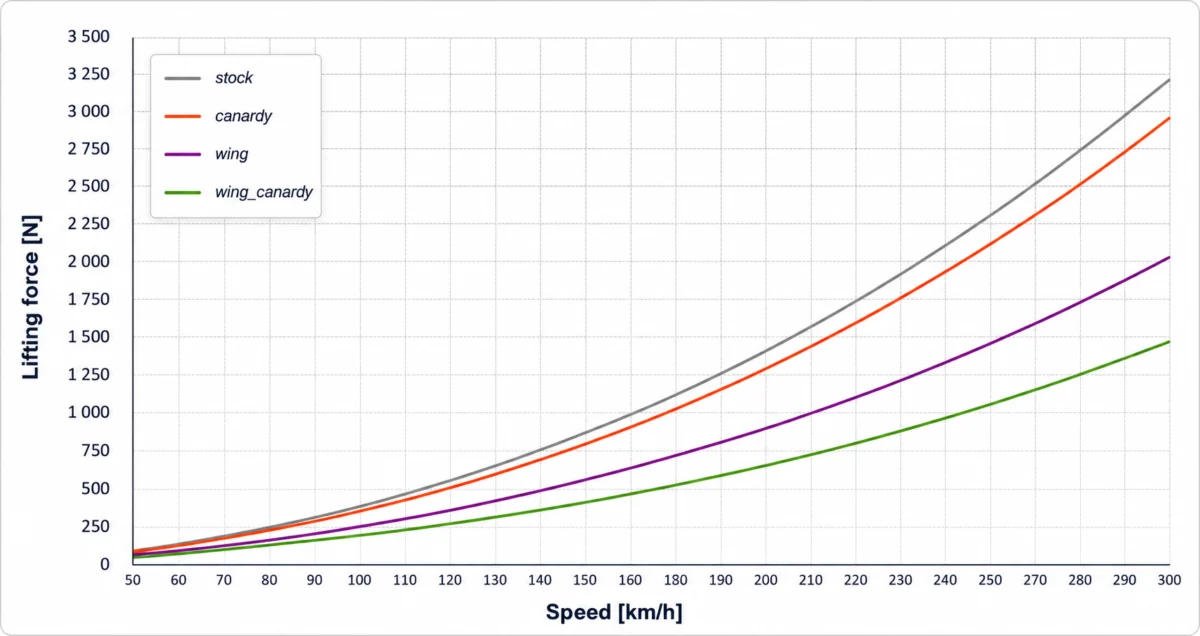
In stock configuration, the Mustang S550 generates positive lift. In simple terms: as speed increases, the body is not being pressed into the road surface – it is being aerodynamically unloaded.
The results for the stock Mustang S550 clearly show how lift increases with speed:
| Speed | Lift Force | Equivalent Mass |
|---|---|---|
| 100 km/h | 359 N | approx. 37 kg |
| 150 km/h | 807 N | approx. 82 kg |
| 200 km/h | 1434 N | approx. 146 kg |
| 250 km/h | 2241 N | approx. 228 kg |
| 300 km/h | 3227 N | approx. 329 kg |
The most important reference point is around 200 km/h. At this speed, the stock Mustang S550 generates roughly 150 kg of lift. This does not mean the car suddenly “takes off from the road.” That would be a major oversimplification. What it does mean is that the effective load on the tires is aerodynamically reduced, which can directly affect stability, vehicle response, and driver confidence at high speeds.
In a track-focused car, every kilogram of tire contact with the asphalt matters – especially under heavy braking, rapid direction changes, or while maintaining stability through high-speed corners.
What Does the Airflow Velocity Map Show?
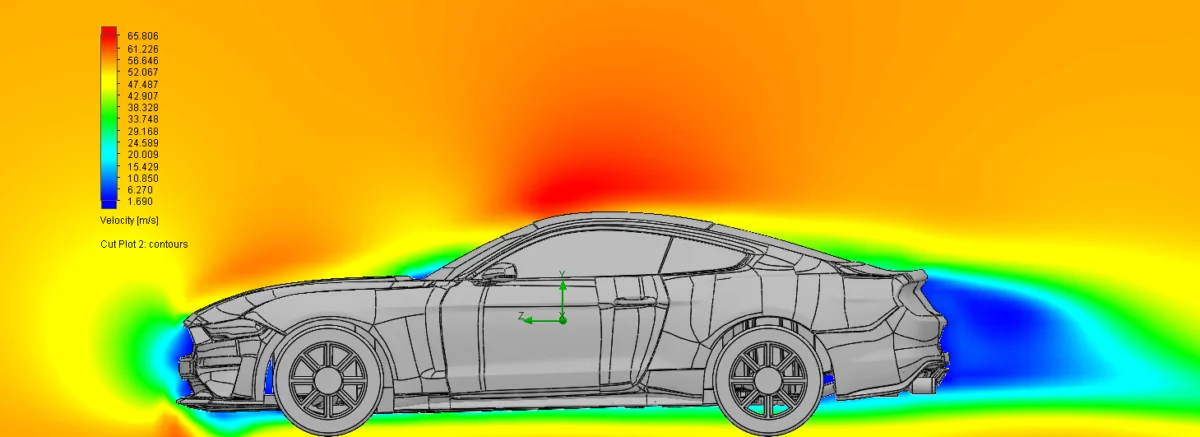
The side-profile airflow visualization reveals several characteristic aerodynamic phenomena.
The first is the acceleration of airflow over the hood, windshield, and roof – which contributes to lift generation. This is a natural result of the body shape. Air has to travel over the vehicle, and the fastback geometry directs the airflow toward the rear section of the car.
The second phenomenon is the disturbed airflow region behind the vehicle. A clearly visible wake zone forms behind the rear section of the body, where airflow loses its organized structure. For a road car, this is normal. However, for a platform being developed toward track-day or time attack use, this is an area worth analyzing in detail.
The third element is the lower airflow region. It becomes clear that the air moving underneath the car and along its sides also contributes to the overall aerodynamic balance. That is why aero development cannot be reduced to a simple assumption like: “add a wing, gain downforce.” First, you need to understand where the air is actually flowing, where it loses energy, and which body regions are creating the biggest aerodynamic compromises.
Fastback Design: Great-Looking, but Aerodynamically Challenging
The Mustang S550 features a body shape that is visually one of its greatest strengths. The problem is that the fastback silhouette comes with an aerodynamic cost at higher speeds.
Around the rear glass and trunk lid area, airflow can begin to separate from the body surface. In practice, this creates a low-pressure region and a less stable airflow wake behind the vehicle. This rear section becomes one of the key areas that must be fully understood before designing a rear wing.
The goal is not to “fight” the factory Mustang shape. The goal is to understand its aerodynamic character and develop components that work with the actual airflow behavior – not simply parts that look aggressive in renders.
Pressure Distribution: Where the Problem Begins
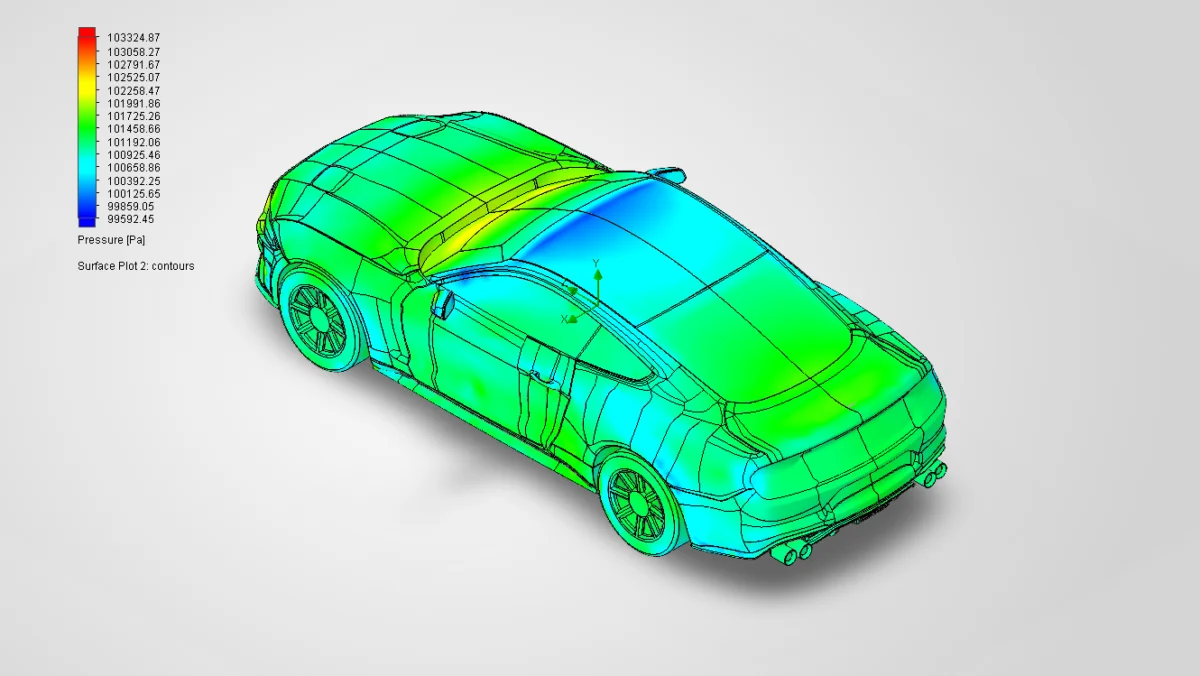
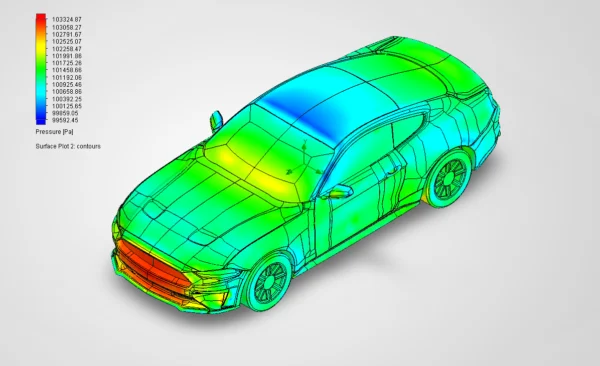
The pressure map shows that Mustang aerodynamics are far from one-dimensional. At the front of the vehicle, areas of elevated pressure are clearly visible – especially around the front fascia. This is where the body first “splits” the incoming airflow.
Further downstream, airflow moves across the hood, windshield, and roof, continuously changing local pressure and velocity. At the rear section of the body, several critical stability-related phenomena begin to appear: flow separation, turbulent wake formation, and a low-pressure region behind the car.
This is exactly why aerodynamics on a car like the Mustang S550 must be developed as a complete system. The front and rear are not separate worlds. What happens around the front bumper corners affects airflow along the sides of the vehicle. What happens over the roof directly affects how a rear wing will operate. And what happens behind the vehicle impacts drag, stability, and the driver’s overall confidence at speed.
Drag: The Cost of Moving Through Air
The second major parameter is drag – aerodynamic resistance:
| Speed | Drag |
|---|---|
| 100 km/h | 431 N |
| 150 km/h | 969 N |
| 200 km/h | 1722 N |
| 250 km/h | 2691 N |
| 300 km/h | 3875 N |
Aerodynamic development always involves compromise. A component that reduces lift or generates downforce may also increase drag. That is why downforce alone is never the only goal. The real objective is achieving a sensible balance between stability, grip, and aerodynamic efficiency.
In the following stages, we will not focus solely on “how much downforce” a component creates. Instead, we will analyze how it changes the overall airflow around the vehicle and whether its operation makes sense within the context of the complete aerodynamic package.
What Does the Stock Mustang S550 Analysis Tell Us?
The stock configuration reveals three key conclusions.
First, the Mustang S550 generates significant lift at high speeds. At approximately 200 km/h, the value approaches 150 kg, which already becomes highly relevant for a vehicle being developed toward serious track performance.
Second, the rear section of the fastback body is one of the most critical aerodynamic areas. Airflow behavior around the rear glass and trunk lid must be controlled if the goal is to improve high-speed stability.
Third, additional aerodynamic components cannot be designed independently from the baseline airflow characteristics. Canards, splitters, rear wings, or underbody elements should solve real aerodynamic issues identified in the analysis – not simply function as styling additions.
What’s Next?
This article is only the starting point.
In the next part, we will show how front canards affect airflow around the Mustang S550. We will analyze whether their role is limited to aggressive styling, or whether they can genuinely organize airflow around the front section of the vehicle and reduce the car’s tendency to generate lift.
Only after that will we move on to the rear wing, before finally presenting the complete configuration – canards and rear wing working together as a unified aerodynamic system.
Because at Restomotive, aerodynamics do not begin with a spoiler.
They begin with data.