
Canards as the First Step in Airflow Control
Canards are not just random add-ons attached to the bumper. Their purpose is not simply to “look motorsport.” In a properly designed aerodynamic system, they can influence local pressure distribution, organize airflow around the front corners of the vehicle, and help guide the air along the sides of the body.
In the Mustang S550, this is particularly important because the stock body generates positive aerodynamic lift. In the first part, we showed that at around 200 km/h, the stock body produces approximately 150 kg of lift. This does not mean the car is “taking off,” but it does show that as speed increases, the effective load on the tires is aerodynamically reduced.
The role of the canards is to reduce this effect and begin controlling the airflow at the very front of the car. They do not solve the entire aerodynamic behavior of the vehicle on their own, but they allow us to see how the body reacts after the first controlled interference with the airflow.
What Does the Pressure Map at the Front Show?
The top-front view of the Mustang clearly shows high-pressure zones on the front fascia. The strongest values appear around the central intake, the lower section of the bumper, and the front corners – exactly where the canards operate.
This matters because the front of the car is the first point of contact with the incoming air. This is where the airflow is split, and where it begins to determine how much air will travel over the hood, along the sides, and underneath the car.
In the canard configuration, the front corners become a more aerodynamically active area. The canards locally alter pressure and airflow direction, which can help reduce chaotic flow separation around the sides of the bumper. This is not yet a complete aerodynamic package, but it is the first component that starts to “set up” the airflow for the rest of the body.

Lift with Canards: Lower, but Still Positive
The most important point is this: canards alone do not turn the stock Mustang into a car that generates full aerodynamic downforce. In this configuration, the vehicle still produces positive lift, but the value is lower than in the stock configuration.
This distinction is important. In aerodynamics, it is easy to oversimplify things and say that “canards create downforce.” In this case, the more accurate statement is that the canards reduce lift and improve airflow control around the front section of the car.
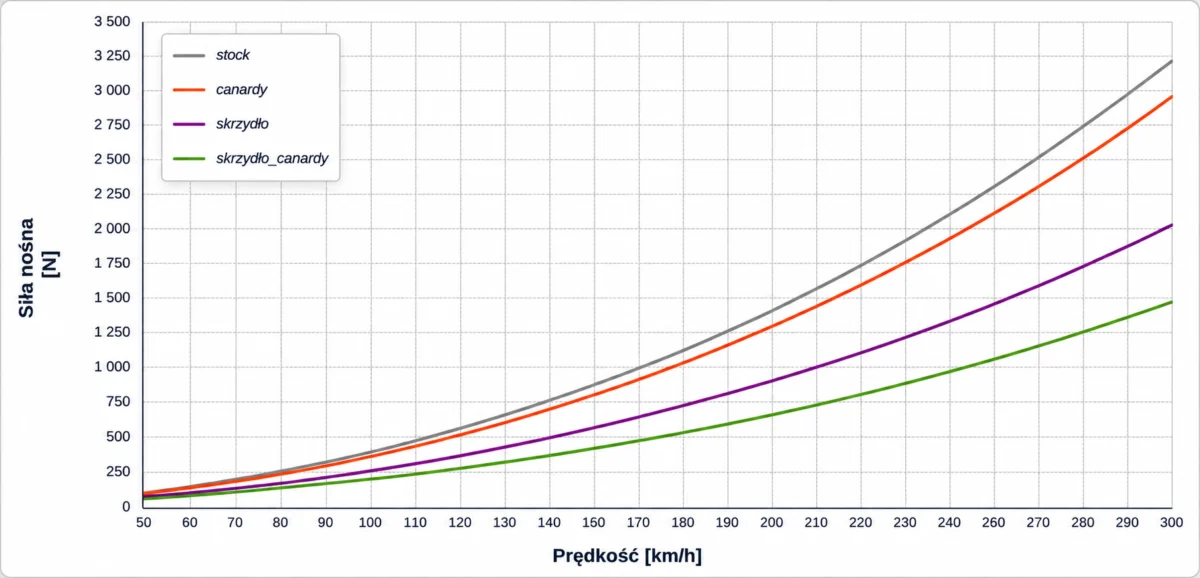
The comparison shows that lift reduction occurs across the entire speed range:
| Prędkość | Seryjny Mustang S550 | Mustang z canardami | Różnica |
|---|---|---|---|
| 100 km/h | 359 N | 332 N | -27 N |
| 150 km/h | 807 N | 746 N | -61 N |
| 200 km/h | 1434 N | 1327 N | -107 N |
| 250 km/h | 2241 N | 2073 N | -168 N |
| 300 km/h | 3227 N | 2986 N | -241 N |
At 200 km/h, the stock Mustang generated approximately 1434 N of lift, which corresponds to around 146 kg. After adding the canards, the value dropped to approximately 1327 N, or around 135 kg of lift. The difference is therefore around 11 kg at this speed. This is not a dramatic change for the entire vehicle, but it is consistent and clearly visible in the data. The canards reduce lift across the full speed range, and their influence increases as speed rises. At 300 km/h, the difference reaches approximately 241 N, or around 25 kg. This shows that the faster the car moves, the more significant even relatively small aerodynamic components become.
Canards Do Not Work in Isolation
The front pressure map shows that the canards mainly affect the local behavior of the front section of the car. High pressure remains visible on the front fascia, while the side areas around the bumper begin to play a greater role in guiding the airflow.
This is important for the next stages of aero development. Canards can help stabilize airflow around the front corners, but they do not solve the complete fastback body problem. The rear section of the car remains extremely important, because this is where the airflow loses structure, separates from the surface, and builds the wake behind the vehicle.
That is why canards should be treated as part of a system, not as a complete solution. Their function only makes full sense when analyzed together with what happens further downstream: along the side skirts, under the car, over the rear glass, around the trunk lid, and finally at the rear wing.

Drag: The Price of Greater Control
Every aerodynamic change comes at a cost. In the case of canards, this is visible in aerodynamic drag.
Canards alter local airflow, generate additional vortex structures, and operate in the high-pressure region at the front of the car. This can help reduce lift, but it also increases drag.
The comparison shows that aerodynamic drag increased compared to the stock configuration:
| Speed | Stock Mustang S550 | Mustang with Canards | Difference |
|---|---|---|---|
| 100 km/h | 431 N | 488 N | +57 N |
| 150 km/h | 969 N | 1097 N | +128 N |
| 200 km/h | 1722 N | 1950 N | +228 N |
| 250 km/h | 2691 N | 3047 N | +356 N |
| 300 km/h | 3875 N | 4388 N | +513 N |
At 200 km/h, drag increased from 1722 N to 1950 N. This means that the improvement in lift control did not come for free.
And this is exactly what real aerodynamic development is about. The goal is not to make every component look impressive in one isolated column of data. The goal is to find the right balance between stability, drag, cornering behavior, and predictability at high speed.
In a track-focused car, additional drag can be acceptable if it results in better stability, improved front-end feel, or more predictable behavior through high-speed sections. But this cannot be judged by eye. It has to be measured and compared with data.
What Does the Underbody View Tell Us?
The underbody view shows that airflow underneath the vehicle remains an important part of the complete aerodynamic balance. Local pressure differences can be seen around the underbody components, wheel areas, and the rear section of the car.
This is a reminder that aerodynamics do not happen only on the hood, bumper, and wing. The air moving underneath the car also affects stability, drag, and the forces acting on the body.
Canards operate at the front, but their influence can continue downstream – along the sides of the car, around the wheel arches, and into the lower airflow regions. That is why the development of further components cannot focus on a single detail in isolation. The entire vehicle must be treated as one connected system of pressure zones and airflow behavior.

What Does the Mustang S550 with Canards Analysis Tell Us?
The canard configuration reveals three key conclusions.
First, the canards reduce lift across the entire analyzed speed range. The effect is not revolutionary, but it is consistent and clearly visible in the data. At 200 km/h, the difference compared to the stock body is approximately 107 N, or around 11 kg.
Second, the canards increase aerodynamic drag. This is the natural cost of modifying airflow at the front of the vehicle. That is why every aero component must be evaluated not only by its ability to reduce lift, but also by its effect on drag and the overall aerodynamic balance of the car.
Third, canards are the beginning of airflow control, not the final solution. Their role is to organize the front section and begin shaping the aerodynamic balance of the vehicle. The full picture will only become clear once we combine them with the rear wing and analyze the complete configuration.
What’s Next?
Part two shows that even a relatively small aerodynamic component can change the airflow behavior around the Mustang S550. The canards reduce lift and begin controlling the front-end airflow, but at the same time, they increase drag and do not yet solve the aerodynamic challenges created by the rear section of the fastback body.
That is why in the next part, we move to the rear wing.
This is where the most important work on the rear of the car begins: controlling airflow behind the roof, influencing the low-pressure region behind the vehicle, and reducing one of the biggest aerodynamic challenges of the Mustang S550 in stock configuration.